Showing posts with label Courses. Show all posts

Friday, 20 September 2013

Scuba Diving in The Gili Islands : It’s a family affair at Trawangan Dive


During 2013 Indonesia as a whole has seen more family holiday makers visiting the country and therefore the Gili Islands have become the perfect island getaway. Trawangan Dive has noticed this trend and has therefore upped its game in terms of accommodation needs and scuba diving programs aimed at families with young children.

In terms of accommodation we have always offered the backpacker rooms as well as our luxury chalet style bungalows which are situated on site surrounded by our lush tropical gardens. Over the course of 2013 we have experienced more families with young children and have noticed more families seeking a more tailor made villa style holiday experience, so therefore we have expanded our range of choices in terms of family orientated accommodation rentals. It’s never been easier to book your villa on Gili Trawangan, simply email your details the Trawangan Dive “Exclusive Villas” department (www.trawangandive.com) and give them your details and requirements. The Trawangan Dive accommodation team will do the rest and find you the perfect place to enjoy you vacation with the family.

We have also noticed a huge increase in the numbers of families wishing to take part in diving programs and therefore have taken the necessary steps to ensure families receive the best possible experience and have also built a brand new luxury family villa in the resort directly next to our dive shop allowing families to fully immerse themselves in the dive schedule whilst at the same time to be able to make full use of their beachside villa.

The rise in families taking dive programs and activities has also prompted us to review the facilities available to young divers, and over the course of 2013 we have taken every step to ensure the safety, satisfaction and overall enjoyment of our programs. Our staff have been fully trained in and briefed in the education and care of PADI junior divers. Our facilities have also endured a complete makeover; having retiled our entire onsite training pool and upgraded our range of equipment for children. Trawangan Dive has received multiple trip advisor reviews from families all over the globe and is looking forward to welcoming more families in the coming years. So if you’re looking to take a family vacation and experience the true wonders of our tropical island and our magnificent ocean, the journey starts here.
Check out The Trawangan Dive Web Page of visit The Trawangan Dive Facebook Page!

To book your perfect diving vacation with the family contact info@trawangandive.com
 

Wednesday, 24 October 2012

Screw university, diving is way better


Corina joined the team at Trawangan Dive a few months ago, after doing her PADI Divemaster and PADI Instructor Development Course with us. As well as being a semi-permanent fixture at any party at the Irish bar, she’s also keeps guests entertained with her quick humour and funny stories. We love her to bits and hope she never leaves!
 
Tell us about yourself Corina..

Young, sexy, big boobs, nice bum. That kind of sums it up!

Quite! Ermm.. anything else?

I’m from Switzerland, I’m 21 years old and I speak English, German, Italian and a weird local dialect called Romanch. There are only 15,000 people that speak it. So super useful.

How did you end up on the island?

I was on a bus in Bali at 6am and I met Sarah one of the dive instructors at Trawangan Dive. She seemed really friendly and she knew I was on my way to Gili Trawangan. She basically dragged me to the dive shop.

Had you been here before?

No. But I heard about it from a best friend who visited it two years ago. It sounded like a lot of fun.

How long have you now been here for?

Since May last year .. almost one and half years.

What made you decide to stay?


I originally came to do some fun dives. But Sarah, with her great sales technique, sold me the PADI Advanced Open Water Diver course. After one week and lots of diving, I tried to leave. My boat and flight to Singapore were booked. After a big night out at a snorkel test, and a little encounter with one of the Divemaster trainees, I was ready to leave, bags packed and everything. I paid my bill. But Adam, Sarah’s boyfriend and also a great salesman, told me to stay and to do my PADI Divemaster.

A group of friends at the dive centre then created a pros and cons list on the whiteboard. The pros list for staying was much longer (of course) and so I decided to stay. The boat, by that point, had left anyway. I crawled back into my room and started my PADI Rescue Diver course the following day. The course lasted ten days because I was in no rush and it was so much fun.

Do you remember your PADI Divemaster course or is it all a blur?!

At that point, my English wasn’t so great and it took me a long time to read the books and study for my exams. My mentor helped me though. Otherwise, it was great fun. I learnt so much and did almost a hundred dives during the course. This was invaluable for when I became an instructor.

Did this mess up plans you might have had at home?

Totally. I was meant to study Geography. I went home after my Divemaster course. I was depressed and cried a lot and I didn’t want to see my friends. I started university but quit two weeks later because I couldn’t be bothered. My heart wasn’t in it. I booked a one way ticket back to Indonesia with the intention of staying for a few months.

And then you did your PADI Instructor Development Course!

Admittedly, I was a bit of a star student because I had done my PADI Divemaster training at Trawangan Dive and all the others had done theirs at different dive centres. It made me realize what a high standard we have here.

What was your diving experience before coming to the island?

I did my PADI Open Water Diver course when 14 in Egypt. When I arrived on Gili Trawangan, I had about 20 dives. As well as Egypt, I’d also dived in Australia and Turkey.

What are you doing now?

Sitting in the office all day and drinking coffee!

I occasionally teach but my main job is now Marketing Manager. I’m responsible for administration of the accommodation at Trawangan Dive. I organize bookings, and travel arrangements for people and make sure all of the rooms are looking lovely.

What are your plans for the future?

Taking over the world. Why not! I’m staying for a while. It’s very difficult to leave. I hope to teach some more. Party some more. Find a rich husband. You know, what every girl dreams of…

If you'd like more information on how to follow in Corina's footsteps, please contact us!

This article originally appeared on www.idc-gili.com.


Protecting our reefs for generations to come

 
Trawangan Dive is proud to be hosting part of the 2012 Biorock training workshop. It will bring professional coral restoration experts and lecturers into the classroom to engage participants in all aspects of coral reef restoration using the definitive Biorock method.
 
Coral reefs are the rainforests of the world’s oceans. Just like their earthly counterparts, they occur in tropical and sub tropical environments and support a huge variety of species. They are also diminishing at an alarming rate.

Decline of the Great Barrier Reef

A study published just a few weeks ago revealed that Australia’s Great Barrier Reef has lost more than half its coral cover in the past 27 years. Researchers analysed data on the condition of 217 individual reefs that make up the World Heritage Site. The results show that coral cover declined from 28.0% to 13.8% between 1985 and 2012. They attribute the decline to storms, a coral-feeding starfish and bleaching linked to climate change.

Asia’s Coral Triangle is also under threat 

Another report has warned that more than 85 percent of reefs in Asia’s Coral Triangle are directly threatened by human activities such as coastal development, pollution and overfishing. Launched at the International Coral Reef Symposium in Cairns, it said the threat was substantially more than the global average of 60 percent and urged greater efforts to reduce destructive fishing and run-off from land.

“When these threats are combined with recent coral bleaching, prompted by rising ocean temperatures, the percent of reefs rated as threatened increases to more than 90 percent,” the report said.

The Coral Triangle covers Indonesia, Malaysia, Papua New Guinea, the Philippines, The Solomon Islands, and East Timor and contains nearly 30 percent of the world’s reefs and more than 3,000 species of fish.

Marine biologists are trying reverse the trend

Marine biologists across the world are desperately trying to protect our remaining reefs. Some are building repositories of the known coral species so that future generations can at least get to see them in aquariums. Others are constructing artificial reefs in areas of significant damage.

Biorock method yields quick results

The biorock method was developed by architect and marine scientist Wolf Hilbertz and marine biologist Tom Goreau. They found that by running a small electrical current through a structure in seawater, a hard shell of calcium carbonate would form on the cathode. You could then attach small pieces of natural coral to the structure. The corals seemed to love these substrates, achieving growth rates often five times faster than normal.

Gili Trawangan – a paradise under threat

Gili Trawangan is one of three tiny coral atolls off the coast of Lombok, Indonesia. It is increasingly a compulsory side trip to any Bali holiday, thanks to its white beaches, diving and snorkelling sites and absence of motor vehicles.

The Gili Islands are dependent on a healthy marine habitat for their fisheries, tourism, shore protection and marine biodiversity. This habitat has been largely damaged by combinations of coral heatstroke, disease, storms, global sea level rise, over-fishing and direct physical damage from destructive fishing practices, boats, anchors and tourists.

Without large-scale restoration of degraded habitats to make them capable of supporting larger fish and shellfish populations, there will be fewer fish in the future.

And without healthy growing corals, there will be fewer beaches or tourism income, affecting all business owners on the island.

Tourist attraction

“Right now we around 60 biorock structures around this island,” says Delphine Robbe. “By the end of this year, we should have one hundred.” Since coming to Gili Trawangan in 2005 with a plan to get her PADI Divemaster certification, this Frenchwoman has become the driving force behind the island’s many eco programmes.

Besides stimulating biodiversity, the Biorock structures also combat beach erosion, which became a serious problem with the destruction of the natural reefs. Increasingly, they are an attraction for tourists too. Divers and snorkelers can now see underwater sculptures of a manta ray, trident, dolphin, turtle, octopus, snake, moon and even a komodo dragon.

2012 Biorock training workshop

Gili Trawangan is proud to be hosting the 2012 Biorock training workshop. It will bring professional coral restoration experts and lecturers into the classroom to engage participants in all aspects of coral reef restoration using the definitive Biorock method.

Workshop sessions will cover all aspects of theory and practice including design, construction, installation, monitoring, maintenance and repair of Biorock sites. Additional lectures will cover the basic principles of coral reef ecology, threats to coral reefs, and environmental restoration.

Over the course of the seven day workshop, participants will have the opportunity to use their knowledge as they plan and invoke all the steps involved in constructing, deploying and populating Biorock structures with coral fragments.

After accomplishing the Biorock workshop, certified PADI instructors can apply to PADI to be able to teach the PADI Distinctive Specialty: Introduction to Biorock process.

If you’d like more information about the Biorock workshop and ways in which you can combine the course with PADI professional courses, please contact us at Trawangan Dive.

This article originally appeared on www.idc-gili.com.

Friday, 12 October 2012

Gap year diver rocks the world


Trawangan Dive’s BioRock Distinctive Specialty Course attracts divers from around the world who want to work on a long-term project with a beneficial environmental impact. It is also a very popular choice for many gap year students. One of our latest arrivals is Pippa, from the UK. She joined us a few weeks ago and has captivated us all with her stories, her diving skills and her professional attitude.
 
Tell us about yourself Pippa…

I’m an 18 year old originally from Hampshire, United Kingdom but I now live in Wensleydale, North Yorkshire. Yes, where the cheese comes from! I’m currently on my gap year before starting a BSc in Marine Biology with Oceanography at Newcastle University next year.

What made you come to the Gili islands?

I wanted to do something conservation and science-oriented in preparation for my studies next year. At a gap year event at my school, I met Ben from Gap Year Divers and he gave me some information about the Gili islands, Trawangan Dive and the BioRock specialty course. It all sounded so perfect.

I’ve been a diver since completing my PADI Junior Open Water Diver at the age of 10. Since then, diving has been a big part of my life and I’ve had my sights set on becoming a PADI Divemaster for a long time.

In addition, some friends had been to the islands before and had amazed me with stories about the culture, the diving and the parties!

What are your first impressions of the Gili islands?

I’d never been to this part of the world before – this is by far the furthest east I’ve been. Everything is so different – the culture, language and cuisine – but you get used to it very quickly.

The Gili islands themselves are beautiful. In one word – paradise! They really are paradise islands, with white sand beaches, swaying palm trees and crystal clear seas. It’s great that there is no form of motorized transport allowed – it’s makes for a very peaceful environment.

Everyone is so friendly and I’ve felt very welcomed since day one. The locals are always smiling and greet you whenever you meet them, even if you’re just walking down the road. It feels a very safe place.

How are you finding it at Trawangan Dive?

It’s very much a home from home and I felt part of the team straight away. When we arrived, we were met by Adam, one of the managers, down at the harbour. He greeted us with a smile and a hug and then bundled us into a horse cart.

It only took a few minutes to arrive at Trawangan Dive and I have to admit I was impressed. It sits right on the beach, overlooking the crystal waters with Gili Meno on the other side of the channel. It looks professional, clean and welcoming. Which was a relief because you can never really tell from looking at pictures on the internet!

I’ve got everything I need here. The food at the restaurant is delicious and there’s lots of variety, from English breakfasts to Mexican fajitas and Indonesia rice dishes. The backpacker rooms are simple but clean. I’ve got a bunk bed room to myself so I have some privacy.

The diving side of things is very well organized and everyone works together as a team. There are so many nationalities working here – English, Scottish, Kiwi, Australian, Swiss, German, French, etc.

Tell us about your previous diving experience

My father is a scuba diver and as a family we go to Mauritius every year for our family holiday. I always really enjoyed snorkelling on the reefs and when I was 10 years old my father enrolled me in the PADI Junior Open Water Diver course. I thoroughly enjoyed it and even got to dive with a pod of wild dolphins on my last dive!

I also completed my PADI Junior Advanced Open Water Diver in Mauritius when I was 15 and then my PADI Rescue Diver course back in the United Kingdom. It was certainly a different experience! I did it at Vobster Quay, a quarry in the south of England. The water was cold and murky and there wasn’t an awful lot to see. I had to wear an 11m wetsuit which is neither comfortable nor flattering!

In addition to those places, I’ve also dived in the Red Sea and the British Virgin Islands.

You’re also a PADI Master Scuba Diver! Congratulations!

I’m pretty proud of myself because I worked quite hard for it. I did most of my PADI specialties including Night Diver, Digital Underwater Photography, Research Diver and Underwater Naturalist, at a company called Action Quest in the British Virgin Islands. In addition, I became an Enriched Air Diver.

How is the PADI Divemaster course going?

I love it! It’s really broadening my knowledge and giving me a whole new take on diving. I’m learning to look at dives and divers from a different perspective.

I’ve already been assisting on a variety of courses, from Discover Scuba Diving to Open Water and Advanced Open Water courses. Over the last few days I’ve also been given the opportunity to play the victim on a Rescue course. I’ve been getting a lot of the theory done and have already completed my first theory exam.

I really appreciate the mentor relationship and am learning a lot from Instructor Jo, but I also like that I get to work with all of the instructors. It’s interesting seeing how each instructor has a different style.

What about some of the cool things you’ve seen underwater here?

I saw my first ever shark at Shark Point the other day! We saw a total of three white tip reef sharks swimming in hundreds of circling jack fish and it was so cool.

There are loads of turtles on the dive sites which is brilliant because they are my favourite marine animal. You can’t go on a dive without seeing at least a couple of them.

I’ve also got to see lots of nudibranch that I’ve never seen before and I spent a good 10 minutes watching a cuttlefish lay some eggs the other day. Amazing!

Your BioRock specialty course is starting soon! Are you looking forward to it?

Absolutely. It’s a new concept that I’d never heard of before. Like most people, I’d heard about the decline of coral reefs around the world, and about coral bleaching and the warming of the ocean. I’d even witnessed this decline first hand having dived in Mauritius for so many years. So I became quite excited when I realized I could work on a project that is designed to combat these problems and help the reefs regrow. I can’t wait until we start building our own structure and then get to sink it and attach the coral. So exciting!

It goes without saying that the course will also massively benefit my university course and give me a lot of material and experience to share with others.

Where else are you going on your gap year?

I’m planning on heading back to Mauritius and I’m going to do my PADI Instructor Development Course with the dive centre where I learnt to dive. It’s like going full circle!

Once that’s completed and I’ve got some teaching experience, I’m going to go back to the British Virgin Islands as I’ve been offered a position as part of the dive staff at Action Quest.

Where do you see yourself in five years time?

My dream has always been to work with the BBC on a series similar to the Blue Planet. I would love to be a research assistant on a program like that, making brilliant television while getting the chance to see nature’s wonders up close and for real. It would also be quite cool to make David Attenborough a cup of tea…

Best of luck with realizing your dream Pippa! 

If you’re interested in improving your diving skills and learning to become a PADI Divemaster or Instructor on a beautiful tropical island, get in touch with us at Trawangan Dive.

This article originally appeared on the Trawangan Dive website for PADI professional courses: www.idc-gili.com

Tuesday, 17 July 2012

How an Essex lad became a dive guru

Anyone who has been to a Trawangan Dive quiz night will be familiar with James, our quizmaster and one of the lead PADI Instructors at our dive resort on Gili Trawangan.
His story from office job to dive god is a familiar tale to many of us in the dive industry. At one point, we all decided to say goodbye to the usual nine-to-five in order to take a leap of faith into the world of diving. And just like the rest of us, James has no intention of ever going back…

What was your previous job?

After studying accountancy at college in Essex, I started my first job with a construction company in East London. I was 18 years old at the time, and I stayed there for 3 years. It was awful, really awful.
The daily commute was mostly spent sitting in someone’s armpit listening to some idiot chatting rubbish on his mobile. The late night’s journey home was inevitably on public transport, trying to avoid catching anyone’s eye in case they had a knife and an attitude.
To be honest, I hated England. It was cold, boring and it never stopped raining. If my family didn’t live there, I could happily never step foot in the country ever again.

Not your happiest moment then! So what did you do?

I saved up some dosh and booked myself on a six month trip around Africa. It was an overland trek in a bus with a bunch of other people who were disillusioned with the real world. It was my first trip outside of Europe so it was big eye opener. We started in Cape Town and I learnt how to dive there. But blimey, it was cold. The water was 13 degrees – we had to wear a 7mm semi-dry and I was still freezing! Despite this, it was an amazing experience and I continued to dive throughout trip.
Lake Malawi was my first taster of diving in fresh water. Lots of different fish and also different planning was required because it was also altitude diving. In Zanzibar I had my first dive in warm water and I couldn’t believe the change it makes. I saw loads of stuff – turtles and lots of different reef fish. In between, the trip included numerous safaris, white water rafting, trekking to see gorillas, etc. It was fantastic. And for six months, I lived in a tent and learnt how to make a fire, how to cook for the group and got in touch with my inner caveman!

Did you head back home at the end of the trip?

Absolutely not! When the trip ended I flew to Bangkok, Thailand and celebrated New Years Eve at a full moon party Koh Pha Ngan. Mental. After a month or so of partying in Thailand, I made my way to Borneo where I volunteered at a wildlife centre called Matang Wildlife Centre. This involved helping with the orangutans, helping to build enclosures and lots of trekking into the mosquito-infested jungle.

After that, I made way round the South-East Asia backpacker circuit including Laos, Cambodia, Philippines and Singapore. I dived whenever I got the chance. In particular, Sipadan blew my mind. There was so much going on during each dive that I didn’t know where to look.

And then, did you head home?

Nah! I applied for a working holiday visa and headed to Australia. I’d always wanted to experience life down under. Rather than making a beeline to Sydney like everyone else, I went to Melbourne. I was worried that Sydney would just be London-on-Sea.
And for the first time in what seemed like ages, I got myself a proper job as an accountant again. It was the easiest way to earn some decent money. After all the travelling I had done, it was nice to enjoy some of the comforts of the developed world again. I had a good group of mates that enjoyed a drink or two, so every night was spent down the pub. And at the weekend, I would try to get away. On one occasion, I headed up to Cairns for a dive trip on the Great Barrier Reef, which was cool, but not really what I expected.

Did you continue your PADI education there?

Actually, it was on the way home that I stopped off in Malaysia and did my next course in the Perhentians islands. I had planned two weeks of chilling on sun-drenched, palm tree lined beach before heading back to the UK. But I was bored after a couple of days so I signed up for my PADI Rescue Diver course with Emergency First Response. It was a fun course with loads of people pretending to pass out underwater or drowning on the surface. I had to tow a fat guy for what seemed like miles. It was good workout.

Were you excited to be going home after so long away?

You would think so. But no, not really. Of course it was nice to see friends and family. But the main reason I went back was because I had run out of money, not because I wanted to return to office life.

Nevertheless, I did get an accounting job again. I figured it was time to grow up and stop running away from responsibilities.

After three months in the job, I realized I didn’t actually want to grow up so I saved up some more money to go travelling again and then quit my job! Again!

How did you find out about Trawangan Dive?

I did a Google search for ‘diving in Indonesia’ and the Gili islands popped up. I emailed various different dive centres and the reply from the manager at the time, Amy, was the quickest and the funniest. That’s all it took! I booked my flight the next day and a month or so later I arrived on the island.

What do you think of the Gili islands?

When I arrived, I was really pleased with my choice. It has the best balance of social life and diving of any island I’ve been to before. Sometimes you arrive in a diving destination and while they are picture perfect, there’s absolutely nothing to do in the evening.

If you don’t want to dive the Gili islands (which would be damn shame) you could still do lots of things – kayaking, sunbathing, snorkeling, horse riding, trek up a volcano in nearby Lombok, etc. Some girls even sunbathe topless so it provides the guys with a nice pastime between dives!

How was your PADI Divemaster Course?

I honestly loved every moment of it. I had Philip as my mentor and it stood me in good stead for the rest of my diving career. I assisted on lots of different courses from – Discover Scuba Diving, Open Water Diver, Advanced Open Water Diver and Rescue Diver courses. Every Divemaster’s favourite is the assist on a Rescue Course – fainting, screaming, puking, bleeding, panicking! So many opportunities to channel my inner drama queen!

I’ve seen you in a fair few costumes since you arrived…

I do love a costume party! I’ve been dressed as Tarzan, a school girl, a go-go dancer, the Hoff, and many more besides. And who can forget the teenage mutant ninja turtles? That was for my snorkel test at the end of my Divemaster course – another mental night I can barely remember!

How did the find PADI IDC?

Ayala is an fantastic PADI Course Director. The two weeks went by so quickly because we were so busy. I was under the impression we would be locked in the classroom all the time, but there were so many workshops, we never seemed to be out of the water.

I think I surprised many (including myself) with my knowledge development presentations. My Essex accent is a constant source of amusement for the people I work with, but in the classroom presentations, apparently I changed my accent and became a polite Englishman speaking the Queen’s English. It’s never happened again since!

And what about the PADI Instructor Examination?

For my PADI IE, we went to Bali. The conditions were much different to those around the Gili islands. We had 5 metre visibility and raging current that made the open water presentations kinda challenging. In comparison to the other groups there, we seemed to be much better prepared and this showed in the final marks – I passed with flying colours!

And so you began your new life as a PADI Instructor…

When I came back I helped out doing some diving and then they offered me a position as a permanent dive instructor at the dive resort. Financially things are much easier now. I can make ends meet without having to dip into savings. In fact, I’m even managing to save a bit as well. I love teaching and the variety it brings. One day I’ll be conducting a Discover Scuba Diving session and the next day I’ll be teaching Deep Specialty or Enriched Air.

What are your plans for the future?

I really want to stay on the island long term and would like to invest some money in property at some point. The island is slowly getting busier as more people are venturing outside of Bali and there are lots of good investment opportunities.

Obviously, I’ll continue to work at Trawangan Dive as well though. This place really is home now. I’m going to continue hosting the weekly quiz night until I get thrown off it! It’s a good laugh. Some people commented the other week that it was the least serious but most entertaining pub quiz they had ever been to. Job done!

Originally published on the Trawangan Dive website for PADI professional courses:

http://www.idc-gili.com/how-an-essex-lad-became-a-dive-guru/

Wednesday, 11 July 2012

Meet Matt, the adrenaline junkie

As scuba divers working in the industry, we all like to think we’re living life to the max. There is a fair amount of excitement in our daily lives – a new dive site to discover, new marine life to marvel at, new conditions to master and obviously new students to teach. Each day brings challenges, fun and stories to tell at the end of it.

And then we met Matt and we realized that our lives were comparatively boring. He arrived at Trawangan Dive nine months ago and it was instantly obvious that he wasn’t your average guy. For a start, he jumps out of planes and off high buildings for fun. As a sky dive instructor and base jumper he really lives life on the edge. Give him a sport and he’ll master it. Motorcross, speed bike racing, Judo, Jiu-jitsu. He pushes himself to the limit in everything he does.

But in his previous line of work, there were many dangers. And after a few too many close calls and reminders that he was still very young, he left Canada to begin a different life. The plan was to travel the world but he got as far as his first destination, Indonesia, and was amazed by life here. And decided to stay…

Were you already a diver?

No. I arrived in Bali and headed to Sanur and completed my PADI Open Water course and PADI Advanced Open Water course. I knew from the first dive that I would take it further. How much further wasn’t clear at that time. But as always, whenever I start a new sport, I want to become the best at it. Diving was the perfect sport for me at this stage in my life. Done properly it has a calming effect. It’s like meditation. And the feeling of weightlessness is like flying but unlike skydiving, everything is a lot slower!

And then you came to the Gili islands…

Yes, I heard about the Gili islands from some people I had met in Bali. I planned to stay for three nights but when I arrived I instantly wanted to stay longer. I’ve realized since that this happens to lots of people! It ticks all the boxes of what people expect of a paradise island – no motor traffic, picture perfect beaches, clear warm seas, amazing marine life and happy people. Also, there’s enough happening on the island to not get bored and enough tranquility to relax. It’s the perfect combination.

What made you choose Trawangan Dive?

I visited many of the dive centres on the island but it was at Trawangan Dive where I felt the most at home. I spoke to all the Divemaster Trainees and asked them about how their course was going. It was obvious they were loving every minute of it. As a French Canadian, I was worried that I would have problems with doing the course in English. But at Trawangan Dive they have an English instructor who speaks fluent French after having lived in France for years and he reassured him he could translate where necessary. That closed the deal.

And so you carried on your education and completed the Emergency First Response (EFR), PADI Rescue Diver and PADI Divemaster courses. Which was your favourite?

I think the PADI Rescue Diver course was my favourite course. The course made me consider not only my own safety but also others. It expanded my awareness and taught me a whole new set of skills. It’s obvious why it’s a compulsory step to becoming a PADI Divemaster because it teaches you the appropriate response to such a wide range of situations, some of which you encounter when you start working with student divers. I can’t thank my instructor enough for his sharing his experience with me – his amusing stories, his insights into the psychology behind rescue situations and his commitment to proper technique.

What did you think about your PADI Divemaster course?

The PADI Divemaster course was a lot of fun! I learnt a lot about the dive industry and how it works. I took every opportunity to dive and logged well over 80 dives during the course. I improved my dive skills and learnt how to deal with customers whether they are students or certified divers. I realized that what makes me tick is helping people overcome fears. I love seeing their faces when they master a skill they were afraid of, such as mask clearing skills. It makes my day when I show new divers their first turtle or bumphead parrotfish. New experiences is what it’s all about.

And you worked as a Divemaster for a while. How was that?

Once I completed my PADI Divemaster course, I knew that I had to become a PADI Open Water Scuba Instructor. If I could have done it sooner I would have done. But I needed to be a diver for at least six months before I completed my PADI Instructor Development Course (IDC). So I worked as a Divemaster in various places to get the experience. In retrospect, it was definitely needed as I learnt so much during that time. No matter how much studying you do or how much time you spend under the watchful eye of an instructor, you don’t really learn until you’re doing if for yourself, every day, with real customers.
 
How did you find the PADI IDC?

The PADI IDC was tough! Mentally it was exhausting because there was so much information to process. Ayala was firm but fair. She was very helpful, she really pushed us and she really prepared us well. Not only for the PADI Instructor Examination but also for the real world. It was obvious why she has a 100% first time pass rate.

How did you feel when you passed the PADI Instructor Examination?

I was so relieved and happy. I felt like I had achieved something amazing. I’d made my way up the PADI ladder and was able to teach another of my passions.

What’s the plan now?

I’m spending the next couple of weeks team teaching with the amazing instructors at Trawangan Dive to learn how they schedule courses. The quality of the instruction is so high that I can learn a lot from these guys. I already have a good idea about scheduling because I assisted on many courses during my Divemaster course. But now I’m obviously looking at things from a different perspective.
I am in the fortunate position of being able to speak three sought-after languages – English, French and Spanish, so I don’t think I’m going to have too many problems finding work. Especially when I’ve got some experience under my belt. And I’m working with Ayala to get my five specialties so I can become a PADI Master Scuba Diver Trainer once I’ve got my first 25 student certifications.
And then we’ll see. There are so many amazing places to work as a dive instructor. I can’t wait to begin exploring the possibilities!

Originally published on the Trawangan Dive website for PADI professional courses:

http://www.idc-gili.com/meet-matt-the-adrenaline-junkie/

Saturday, 31 March 2012

100% AWARE


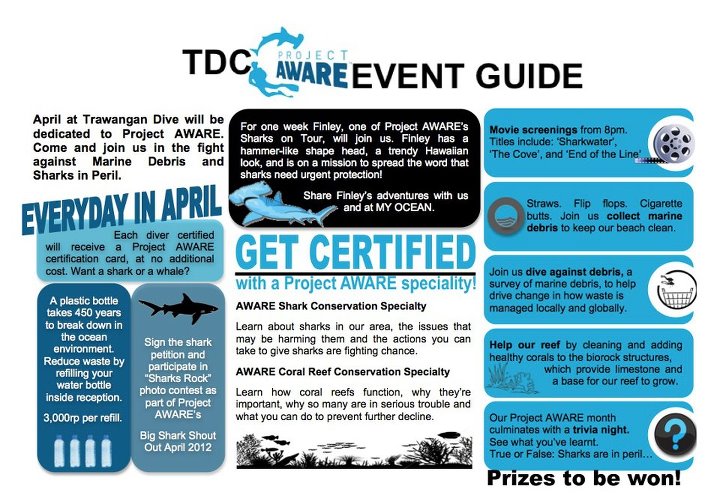
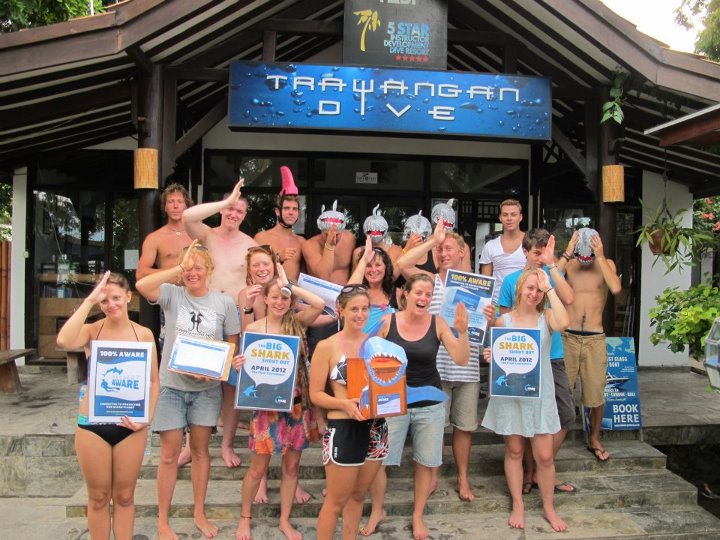
AWARE month is now up and running at Trawangan Dive. For every diver we certify we will be donating money to Project AWARE, and each of our divers will recieve a free Project AWARE card! We are also running events through out the month of April making our customers 100% AWARE. 
Keep up to date with all the latest right here:

James teaching

Event Guide for April

Events during April


Supporting the cause

Instructor James!

Trawangan Dive Team!!