Showing posts with label Project AWARE. Show all posts

Sunday, 14 July 2013

It's a messy job..


Meet Sian Williams, Trawangan Dive’s very own Éco Warrior’.  Sian came to Trawangan Dive in March 2012 to take part in a 2 week Biorock programme.  Naturally, she fell in love with the Island, the Dive Centre (and the staff).  She also saw Delphine Robbe , (Gili Trawangan’s original Éco Warrior’), struggling to single-handedly maintain the island’s growing Biorock, population, control the marine debris, while keeping the island clean of rubbish, and more recently, being a mum.

Sian made the decision to dedicate her life, (or the next few years of it anyway), to helping with the marine conservation of our tiny island. 

Sian is based out of Trawangan Dive.  She is a PADI Open Water Scuba Instructor, and can also teach the PADI ‘Introduction to Biorock process'speciality.  She dedicates her time to maintaining the Biorocks, running regular beach clean ups, dives against debris, reef check, reef gardening, island clean ups, and generally cleaning up after the thousands of people that pollute Gili Trawangan and the surrounding reefs with non-biodegradable plastic, cigarette butts, glass, flip flops, lighters, light bulbs, fishing line, and fish hooks.


This kind of work usually receives little recognition or thanks, but carries with it a huge amount of frustration and stress.  No sooner have you finished maintaining one Biorock, then another one breaks, or gets unplugged, or is destroyed by a storm.  Moments after one beach clean up has finished, another boat load of people wielding a fresh delivery of cigarettes and plastic bags arrives. While most of us go about our normal day not giving a second though about who will pick up that discarded nappy, or who will spend hours unravelling the kilometres of embedded fishing line from the reefs, it’s people like Sian who dedicate their time to tasks like this.
Sian has developed some eco alternatives for divers interested in conservation, marine ecology or just wanting to give something back to the ocean.  

Introduction to reef gardening – Single dive 470,000rp

  • Learn how to identify broken, overturned live corals that with our help, have a second chance of survival. 
  • Learn how to safely pick up heavy corals and to find suitable substrate to transplant onto for the coral to attach to once overturned and secured.
  • Gain reef conservation skills you can take with you travelling and diving around the world
  • Dive includes all equipment including protective gloves and briefing on identification of corals to focus on and present reef state around the Gilis.

Dive Against Debris - Single dive 400,000rp
  •  Equipped with protective gloves and a mesh debris bag divers will go out in buddy teams to different reefs collecting as much non organic waste as possible.
  • Debris is separated, weighed and recorded onto a Project AWARE debris data sheet to submit to Project AWARE
  • Dive includes protective gloves and mesh bag, briefing and Dive Against Debris ID guide to know what to look for and collect, data sheets to analyse debris data.
Biorock Fundive –Single dive 400,000
  • Learn what a Biorock is whilst diving around the world’s largest concentration of Biorock reef structures.
  • Briefing includes why the Gili islands reefs depend on artificial reef restoration. The basics of what a Biorock is and how it is advantageous to Gili islands tourism, fish populations and reefs. 
  •  Help our volunteers’ check the structures are on, working properly and harbouring the correct corals. 
  •  Bring along your underwater camera and get a picture on our very own Deus motorbike Biorock.
  • Dive includes short briefing on the Biorock technology, how long our Biorocks have been established, the age and condition of each Biorock you will see.
Introduction to the Biorock Process, 1 or 2 day PADI speciality 2,000,000rp
  •  Learn about coral ecology and the importance of coral reefs in the marine environment. The course raises awareness to the state of coral reefs global and the need for awareness and responsible behaviour to protect remaining healthy reefs. 
  •  Divers will also be introduced to the Biorock process and technology and why it is so successful.
  • Take part in training to identify damaged coral reefs, the causes of destruction and the use of Biorock technology for restoration and erosion prevention.
  •  Learn how a Biorock works and why they are more successful than other reef restoration techniques. Will also gain an insight into how they are advantageous in preventing coastal erosion and eco tourism.
  • Gain a PADI Distinctive Speciality certification
  • Course includes 2 dives, at least one around the Biorock structures. The divers will learn to identify species of coral and the status of the corals on reefs and also on Biorock structures to compare. You will also learn how to recognize coral bleaching, disease and predation with underwater identification slates, whilst gaining a PADI speciality certification.
Email info@trawangandive.com for more information.

Wednesday, 24 October 2012

Protecting our reefs for generations to come

 
Trawangan Dive is proud to be hosting part of the 2012 Biorock training workshop. It will bring professional coral restoration experts and lecturers into the classroom to engage participants in all aspects of coral reef restoration using the definitive Biorock method.
 
Coral reefs are the rainforests of the world’s oceans. Just like their earthly counterparts, they occur in tropical and sub tropical environments and support a huge variety of species. They are also diminishing at an alarming rate.

Decline of the Great Barrier Reef

A study published just a few weeks ago revealed that Australia’s Great Barrier Reef has lost more than half its coral cover in the past 27 years. Researchers analysed data on the condition of 217 individual reefs that make up the World Heritage Site. The results show that coral cover declined from 28.0% to 13.8% between 1985 and 2012. They attribute the decline to storms, a coral-feeding starfish and bleaching linked to climate change.

Asia’s Coral Triangle is also under threat 

Another report has warned that more than 85 percent of reefs in Asia’s Coral Triangle are directly threatened by human activities such as coastal development, pollution and overfishing. Launched at the International Coral Reef Symposium in Cairns, it said the threat was substantially more than the global average of 60 percent and urged greater efforts to reduce destructive fishing and run-off from land.

“When these threats are combined with recent coral bleaching, prompted by rising ocean temperatures, the percent of reefs rated as threatened increases to more than 90 percent,” the report said.

The Coral Triangle covers Indonesia, Malaysia, Papua New Guinea, the Philippines, The Solomon Islands, and East Timor and contains nearly 30 percent of the world’s reefs and more than 3,000 species of fish.

Marine biologists are trying reverse the trend

Marine biologists across the world are desperately trying to protect our remaining reefs. Some are building repositories of the known coral species so that future generations can at least get to see them in aquariums. Others are constructing artificial reefs in areas of significant damage.

Biorock method yields quick results

The biorock method was developed by architect and marine scientist Wolf Hilbertz and marine biologist Tom Goreau. They found that by running a small electrical current through a structure in seawater, a hard shell of calcium carbonate would form on the cathode. You could then attach small pieces of natural coral to the structure. The corals seemed to love these substrates, achieving growth rates often five times faster than normal.

Gili Trawangan – a paradise under threat

Gili Trawangan is one of three tiny coral atolls off the coast of Lombok, Indonesia. It is increasingly a compulsory side trip to any Bali holiday, thanks to its white beaches, diving and snorkelling sites and absence of motor vehicles.

The Gili Islands are dependent on a healthy marine habitat for their fisheries, tourism, shore protection and marine biodiversity. This habitat has been largely damaged by combinations of coral heatstroke, disease, storms, global sea level rise, over-fishing and direct physical damage from destructive fishing practices, boats, anchors and tourists.

Without large-scale restoration of degraded habitats to make them capable of supporting larger fish and shellfish populations, there will be fewer fish in the future.

And without healthy growing corals, there will be fewer beaches or tourism income, affecting all business owners on the island.

Tourist attraction

“Right now we around 60 biorock structures around this island,” says Delphine Robbe. “By the end of this year, we should have one hundred.” Since coming to Gili Trawangan in 2005 with a plan to get her PADI Divemaster certification, this Frenchwoman has become the driving force behind the island’s many eco programmes.

Besides stimulating biodiversity, the Biorock structures also combat beach erosion, which became a serious problem with the destruction of the natural reefs. Increasingly, they are an attraction for tourists too. Divers and snorkelers can now see underwater sculptures of a manta ray, trident, dolphin, turtle, octopus, snake, moon and even a komodo dragon.

2012 Biorock training workshop

Gili Trawangan is proud to be hosting the 2012 Biorock training workshop. It will bring professional coral restoration experts and lecturers into the classroom to engage participants in all aspects of coral reef restoration using the definitive Biorock method.

Workshop sessions will cover all aspects of theory and practice including design, construction, installation, monitoring, maintenance and repair of Biorock sites. Additional lectures will cover the basic principles of coral reef ecology, threats to coral reefs, and environmental restoration.

Over the course of the seven day workshop, participants will have the opportunity to use their knowledge as they plan and invoke all the steps involved in constructing, deploying and populating Biorock structures with coral fragments.

After accomplishing the Biorock workshop, certified PADI instructors can apply to PADI to be able to teach the PADI Distinctive Specialty: Introduction to Biorock process.

If you’d like more information about the Biorock workshop and ways in which you can combine the course with PADI professional courses, please contact us at Trawangan Dive.

This article originally appeared on www.idc-gili.com.

Friday, 25 May 2012

AWARE Month Success


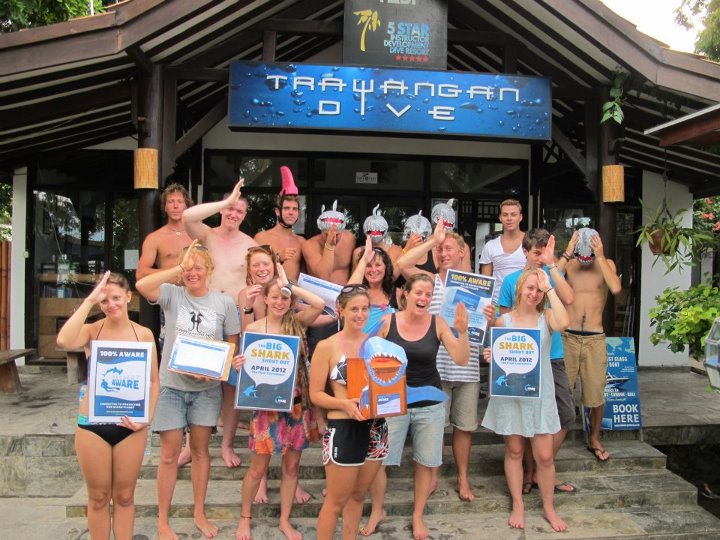
In April 2012 Trawangan Dive signed up to participate in Project Aware's 100% AWARE month.  During April’s Big Shark Shout Out, we joined with other divers worldwide and called for greater protection from overexploitation: overfishing, finning, and bycatch. Throughout the whole month of April we set up lots of different events in order to promote and increase awareness of Project AWARE's big shark shout out!

All the Staff getting involved

Trawangan Dive's 100% AWARE promotional video:

During April we thought it would be a good idea to go viral and make a video that would get peoples attention  and help raise awareness for Sharks. At the time we had two Divemaster Trainee's Nick and Helen who were both hearing impaired so we thought we'd get the message across in Sign Language! They taught all the Instructors and Divemasters various amounts of sign language, some of which couldn't have been included in the video! A big thanks to all the staff at Trawangan Dive who took part in the video, we all had great fun making it! Please like and share our video to help get our message out there!


Finely's Trip to Gili Trawangan:
We were very pleased during the month of April to receive a visit from Project Aware's very own Finely the shark. Finley is touring the world to rally support for shark conservation and encouraging people from around the world to sign the Shark petition! For you to save the Sharks please sign Projects Aware's Shark Petition by visiting Trawangan Dive's Facebook Page. During Finley's visit, we got him involved in all the action from diving against debris and joining us on our divemasters snorkel tests!


Look who's arrived!

Finley joins in the fun of Nick and Helen's Divemaster Snorkel Test!


100% AWARE Quiz Night:


During Trawangan Dive's weekly Quiz night we decided during the month of April to base the Quiz around Project Aware. Thanks to our Instructors James Wells and Jo Hurford, for organising and hosting the Quiz. Included in the quiz was a sock puppet round were by Jo and James had previously filmed themselves acting various films for our amusement! It was then audience's turn to guess the film it was from, the films included Jaws to Finding Nemo! Other rounds included Fish charades (James making a fool out of himself), General ocean facts, Project Aware facts and other Conservation facts. The quiz was a great turn out, thanks to all who came and joined in the fun and made a donation towards Project Aware.


James hosting Project Aware Quiz Night


If you would like further information on this great cause and how you can become apart of it please email us at info@trawangandive.com or visit http://www.projectaware.org/


Saturday, 31 March 2012

100% AWARE


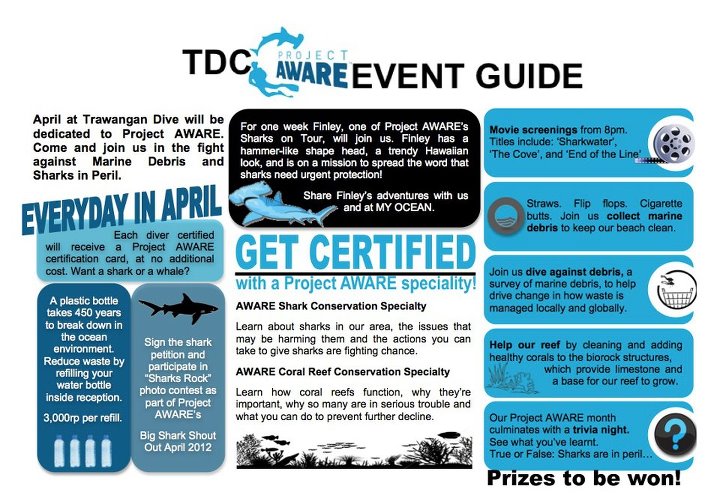
AWARE month is now up and running at Trawangan Dive. For every diver we certify we will be donating money to Project AWARE, and each of our divers will recieve a free Project AWARE card! We are also running events through out the month of April making our customers 100% AWARE. 
Keep up to date with all the latest right here:

James teaching

Event Guide for April

Events during April


Supporting the cause

Instructor James!

Trawangan Dive Team!!