Tuesday, 14 May 2013

Getting Technical


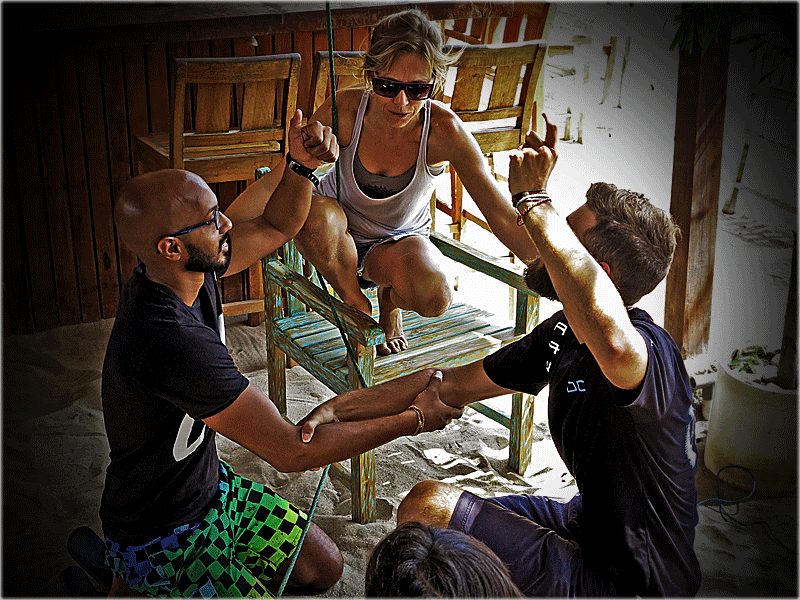
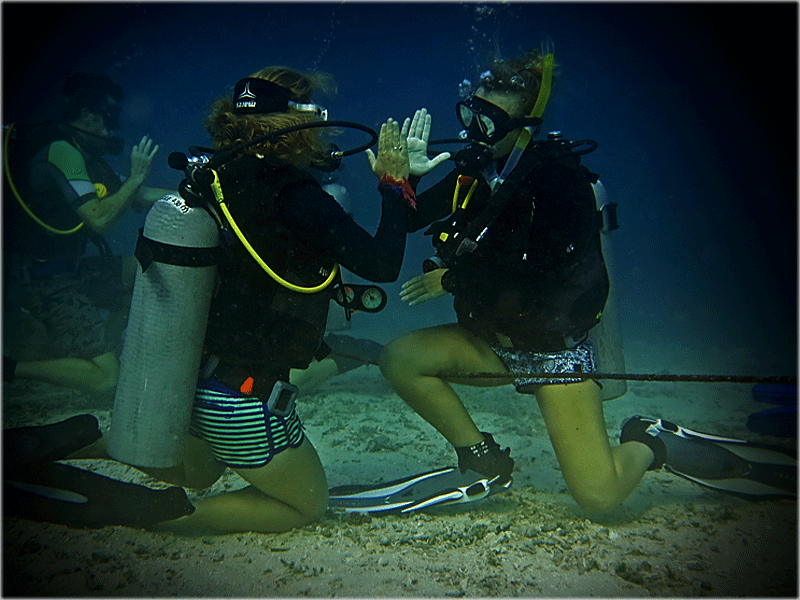
TDI Instructor Adam Baxter with Advanced Nitrox and Decompression Procedures students Jamie Rowe and George Drain
This year Trawangan Dive has been getting technical, offering a full range of tec diving programs. Our customers have been able to break the recreational limits of diving and explore the deeper walls and untouched reefs around the Gili Islands and the coast of Lombok.  Takat Tunang is just one example, with walls reaching depths of over 150m.  This dive site boasts some of the most pristine corals and biggest schools of pelagic fish in the region.  

Other keen explorers have been lucky enough to dive the Japanese Wreck, a WWII Japanese patrol boat believed to have been scuttled in 1945.  At about 20m long and 7m wide, it remains in good condition lying at 45m off the coast of Lombok.  Trawangan Dive Director, Simon Liddiard, spent over a month looking for the wreck and has kept the location of the dive site a secret.  Trawangan Dive is one of the only dive centres with the coordinates.

Not just for grown ups.
You don’t have to be ‘technically minded’ to be a technical diver so don’t be put off by the name.  Children as young as twelve can participate in the PADI Enriched Air Diver specialty.  You can even use Nitrox on your PADI Open Water Course.  It’s as easy as that!  Being an Enriched Air Diver allows divers to increase no stop (no decompression) dive time using blends of up to 40% oxygen.
From as young as fifteen years of age, you can continue your technical training with the TDI Advance Nitrox Diver Course.  To complete this course you must already hold your Nitrox Diver certificate and have proof that you have done at least 25 logged open water dives.  

The objective of this course is to teach the benefits, hazards and proper procedures for using enriched air all the way up to 100% oxygen.  Upon successful completion of this course, blends of oxygen from 40 through to 100% for optimal mixes to a maximum depth of 40m can be used.  

Tec students George and Jamie getting familiar with twin tanks
Want to break the limits?
 
Sorry kids – you need to be at least eighteen years of age to participate in the TDI Decompression Procedures course.  You also need to need to be an Advanced Diver, but you still only need to have 25 logged dives.

By the end of this course, you will be able to plan and conduct a staged decompression dive not exceeding a maximum depth of 45m.  Upon successful completion of the course divers can engage in decompression diving activities.

We love recycling so much – we’re even recycling air!
Trawangan Dive has seen a huge influx of rebreather divers this year, which is no great surprise since the three Directors of Trawangan Dive are all keen rebreather owners and enthusiasts.  

Also boasting a climate controlled tec room, Trawangan Dive is the obvious choice if you’re bringing your expensive equipment to the island and want to store it safely.


Ida, Patrick and Ganesh returning from a dusk dive on their rebreathers

Want to get involved?  Visit www.trawangandive.com or email info@trawangandive.com.

Wednesday, 24 October 2012

Screw university, diving is way better


Corina joined the team at Trawangan Dive a few months ago, after doing her PADI Divemaster and PADI Instructor Development Course with us. As well as being a semi-permanent fixture at any party at the Irish bar, she’s also keeps guests entertained with her quick humour and funny stories. We love her to bits and hope she never leaves!
 
Tell us about yourself Corina..

Young, sexy, big boobs, nice bum. That kind of sums it up!

Quite! Ermm.. anything else?

I’m from Switzerland, I’m 21 years old and I speak English, German, Italian and a weird local dialect called Romanch. There are only 15,000 people that speak it. So super useful.

How did you end up on the island?

I was on a bus in Bali at 6am and I met Sarah one of the dive instructors at Trawangan Dive. She seemed really friendly and she knew I was on my way to Gili Trawangan. She basically dragged me to the dive shop.

Had you been here before?

No. But I heard about it from a best friend who visited it two years ago. It sounded like a lot of fun.

How long have you now been here for?

Since May last year .. almost one and half years.

What made you decide to stay?


I originally came to do some fun dives. But Sarah, with her great sales technique, sold me the PADI Advanced Open Water Diver course. After one week and lots of diving, I tried to leave. My boat and flight to Singapore were booked. After a big night out at a snorkel test, and a little encounter with one of the Divemaster trainees, I was ready to leave, bags packed and everything. I paid my bill. But Adam, Sarah’s boyfriend and also a great salesman, told me to stay and to do my PADI Divemaster.

A group of friends at the dive centre then created a pros and cons list on the whiteboard. The pros list for staying was much longer (of course) and so I decided to stay. The boat, by that point, had left anyway. I crawled back into my room and started my PADI Rescue Diver course the following day. The course lasted ten days because I was in no rush and it was so much fun.

Do you remember your PADI Divemaster course or is it all a blur?!

At that point, my English wasn’t so great and it took me a long time to read the books and study for my exams. My mentor helped me though. Otherwise, it was great fun. I learnt so much and did almost a hundred dives during the course. This was invaluable for when I became an instructor.

Did this mess up plans you might have had at home?

Totally. I was meant to study Geography. I went home after my Divemaster course. I was depressed and cried a lot and I didn’t want to see my friends. I started university but quit two weeks later because I couldn’t be bothered. My heart wasn’t in it. I booked a one way ticket back to Indonesia with the intention of staying for a few months.

And then you did your PADI Instructor Development Course!

Admittedly, I was a bit of a star student because I had done my PADI Divemaster training at Trawangan Dive and all the others had done theirs at different dive centres. It made me realize what a high standard we have here.

What was your diving experience before coming to the island?

I did my PADI Open Water Diver course when 14 in Egypt. When I arrived on Gili Trawangan, I had about 20 dives. As well as Egypt, I’d also dived in Australia and Turkey.

What are you doing now?

Sitting in the office all day and drinking coffee!

I occasionally teach but my main job is now Marketing Manager. I’m responsible for administration of the accommodation at Trawangan Dive. I organize bookings, and travel arrangements for people and make sure all of the rooms are looking lovely.

What are your plans for the future?

Taking over the world. Why not! I’m staying for a while. It’s very difficult to leave. I hope to teach some more. Party some more. Find a rich husband. You know, what every girl dreams of…

If you'd like more information on how to follow in Corina's footsteps, please contact us!

This article originally appeared on www.idc-gili.com.


Protecting our reefs for generations to come

 
Trawangan Dive is proud to be hosting part of the 2012 Biorock training workshop. It will bring professional coral restoration experts and lecturers into the classroom to engage participants in all aspects of coral reef restoration using the definitive Biorock method.
 
Coral reefs are the rainforests of the world’s oceans. Just like their earthly counterparts, they occur in tropical and sub tropical environments and support a huge variety of species. They are also diminishing at an alarming rate.

Decline of the Great Barrier Reef

A study published just a few weeks ago revealed that Australia’s Great Barrier Reef has lost more than half its coral cover in the past 27 years. Researchers analysed data on the condition of 217 individual reefs that make up the World Heritage Site. The results show that coral cover declined from 28.0% to 13.8% between 1985 and 2012. They attribute the decline to storms, a coral-feeding starfish and bleaching linked to climate change.

Asia’s Coral Triangle is also under threat 

Another report has warned that more than 85 percent of reefs in Asia’s Coral Triangle are directly threatened by human activities such as coastal development, pollution and overfishing. Launched at the International Coral Reef Symposium in Cairns, it said the threat was substantially more than the global average of 60 percent and urged greater efforts to reduce destructive fishing and run-off from land.

“When these threats are combined with recent coral bleaching, prompted by rising ocean temperatures, the percent of reefs rated as threatened increases to more than 90 percent,” the report said.

The Coral Triangle covers Indonesia, Malaysia, Papua New Guinea, the Philippines, The Solomon Islands, and East Timor and contains nearly 30 percent of the world’s reefs and more than 3,000 species of fish.

Marine biologists are trying reverse the trend

Marine biologists across the world are desperately trying to protect our remaining reefs. Some are building repositories of the known coral species so that future generations can at least get to see them in aquariums. Others are constructing artificial reefs in areas of significant damage.

Biorock method yields quick results

The biorock method was developed by architect and marine scientist Wolf Hilbertz and marine biologist Tom Goreau. They found that by running a small electrical current through a structure in seawater, a hard shell of calcium carbonate would form on the cathode. You could then attach small pieces of natural coral to the structure. The corals seemed to love these substrates, achieving growth rates often five times faster than normal.

Gili Trawangan – a paradise under threat

Gili Trawangan is one of three tiny coral atolls off the coast of Lombok, Indonesia. It is increasingly a compulsory side trip to any Bali holiday, thanks to its white beaches, diving and snorkelling sites and absence of motor vehicles.

The Gili Islands are dependent on a healthy marine habitat for their fisheries, tourism, shore protection and marine biodiversity. This habitat has been largely damaged by combinations of coral heatstroke, disease, storms, global sea level rise, over-fishing and direct physical damage from destructive fishing practices, boats, anchors and tourists.

Without large-scale restoration of degraded habitats to make them capable of supporting larger fish and shellfish populations, there will be fewer fish in the future.

And without healthy growing corals, there will be fewer beaches or tourism income, affecting all business owners on the island.

Tourist attraction

“Right now we around 60 biorock structures around this island,” says Delphine Robbe. “By the end of this year, we should have one hundred.” Since coming to Gili Trawangan in 2005 with a plan to get her PADI Divemaster certification, this Frenchwoman has become the driving force behind the island’s many eco programmes.

Besides stimulating biodiversity, the Biorock structures also combat beach erosion, which became a serious problem with the destruction of the natural reefs. Increasingly, they are an attraction for tourists too. Divers and snorkelers can now see underwater sculptures of a manta ray, trident, dolphin, turtle, octopus, snake, moon and even a komodo dragon.

2012 Biorock training workshop

Gili Trawangan is proud to be hosting the 2012 Biorock training workshop. It will bring professional coral restoration experts and lecturers into the classroom to engage participants in all aspects of coral reef restoration using the definitive Biorock method.

Workshop sessions will cover all aspects of theory and practice including design, construction, installation, monitoring, maintenance and repair of Biorock sites. Additional lectures will cover the basic principles of coral reef ecology, threats to coral reefs, and environmental restoration.

Over the course of the seven day workshop, participants will have the opportunity to use their knowledge as they plan and invoke all the steps involved in constructing, deploying and populating Biorock structures with coral fragments.

After accomplishing the Biorock workshop, certified PADI instructors can apply to PADI to be able to teach the PADI Distinctive Specialty: Introduction to Biorock process.

If you’d like more information about the Biorock workshop and ways in which you can combine the course with PADI professional courses, please contact us at Trawangan Dive.

This article originally appeared on www.idc-gili.com.

Thinking about becoming a PADI professional?


Pick up any diving magazine or surf the web for dive related websites, and you’ll find lots of images taken in exotic destinations combined with interactions with aquatic life. In certain people, this often stimulates the dream of working full time as a dive professional.

There are few professions in the world where you can spend a Monday morning commuting to your work place on a boat, enjoying beautiful weather with customers who admire you for the job you do.

You’ll never forget your first breath

Most divers never forget their first breath underwater during their initial confined water training. For the majority of scuba participants, the entry level certification opens a whole new world. For some, it creates the dream and goal of becoming a scuba diving professional.

Build your self esteem

Scuba diving is a sport that builds self esteem and improves physical fitness. It also creates an environmental awareness and shows individuals how to make a positive contribution to the aquatic world.

Unlike many other sports, scuba diving is non-contact, three-dimensional and multi sensory. The competition is with each individual to better themselves as a diver, not over others. Whilst many divers enjoy the silence and serenity of the underwater world, scuba diving is also a very social activity and fosters camaraderie amongst participants and leads to lifelong friendships.

You’ll make a positive difference 

As a scuba diving professional, you get to make a positive difference to other people’s lives and to the environment. Whether an individual seeks scuba instruction to learn about the environment, as a self fulfilment goal or to challenge themselves, you become a facilitator and help them dive safely and have enjoyable experiences.

The PADI system of education

The PADI system of diver education has some of the most comprehensive educational products. It’s a system that enables the instructor to work more on individualized instruction as most students are free to learn at their own pace.

This allows for you as the instructor to focus on individual needs, remediation and delivering the course in a fun and effective manner.

These materials can be used anywhere in the world to teach a standardized course. However, the instructor will need to adapt each course to the local environment and culture, which is something you will be taught to do.

Work wherever you choose

PADI instructors can choose to work part or full time in tropical resorts or local dive centres. Many instructors also have their own full time jobs and work in their spare time or weekends as either freelance instructors or through a local PADI dive centre.

In the resort environment many instructors enjoy teaching on tropical islands in warm waters on beautiful coral reefs with an abundance of fish and other aquatic life. It’s obviously this dream lifestyle that motivates many individuals to switch careers.

Join the tribe – become a PADI Divemaster

There are different methods of completing the Divemaster course; it can be done through a local dive centre, on a part time basis, either interning on classes or via practical simulated training components. Many candidates choose to take time out and intern on a program over several weeks in the tropics, and get real world hands on exposure whilst training.

Take the plunge – become a PADI Instructor

The next step after the PADI Divemaster course is to enrol in either the PADI Assistant Instructor course, or the complete PADI Instructor Development Course.

To have the best chances of employment within the dive industry, and to make a reasonable pay, then the instructor rating is a logical progression after the Divemaster course.

What you can teach

As a PADI Open Water Scuba Instructor, you can conduct introductory programs such as Discover Snorkelling and Discover Scuba Diving, and certification courses from the PADI Open Water Diver, PADI Advanced Open Water Diver, PADI Rescue Diver and the PADI Divemaster course.

It is also possible to teach specialty classes such as Enriched Air/Nitrox, Digital Photography, Deep, Wreck or Fish Identification upon taking a specialty instructor class or with sufficient experience.

Sounds amazing! What’s the catch?

PADI instructors seem to have the dream job. They get to work in exotic locations, they dive for a living, they interact with nature, and their students look up to them like heroes. In addition, they get paid for all this.

But teaching requires a special set of skills including patience, adaptability, open mindedness and basic business principles in customer service and marketing.

Often, the job of a PADI Divemaster or instructor has long hours. It can require the person to truly multitask and there may be significant periods without days off.

However if you talk to an instructor at the end of a bad days work, the majority would not swap it for anything else in the world.

It’s not all about the money, money, money

Whilst the job may not have the highest pay scales and most instructors do not work solely for money, the pay can be enough to allow good savings after a season. This could be used to finance a flight to the next destination, purchase new equipment and reinvest in additional training, or simply to bank.

If wealth could be measured in job satisfaction, then PADI instructors would probably be the wealthiest professionals on the planet, and with a life they could look back on with the biggest of smiles.

Branch out and discover new avenues

Many instructors work for a period of a few years teaching recreational classes then advance into more senior positions.

Friends who I have worked with now hold prominent positions in the scuba diving industry – from working as PADI Regional Managers, to owners of live boards, to PADI Course Directors. Others own or manage dive centres and resorts, and some specialize in technical diving and exploration.
When I think back to the career path I had originally chosen, in international financial institutions, I never for one day regret my choice – where it has taken me, the people I have met, and the memories I have.

If you'd like more information about the courses we offer at Trawangan Dive, please contact us.

This article originally appeared on www.idc-gili.com.

Friday, 12 October 2012

Gap year diver rocks the world


Trawangan Dive’s BioRock Distinctive Specialty Course attracts divers from around the world who want to work on a long-term project with a beneficial environmental impact. It is also a very popular choice for many gap year students. One of our latest arrivals is Pippa, from the UK. She joined us a few weeks ago and has captivated us all with her stories, her diving skills and her professional attitude.
 
Tell us about yourself Pippa…

I’m an 18 year old originally from Hampshire, United Kingdom but I now live in Wensleydale, North Yorkshire. Yes, where the cheese comes from! I’m currently on my gap year before starting a BSc in Marine Biology with Oceanography at Newcastle University next year.

What made you come to the Gili islands?

I wanted to do something conservation and science-oriented in preparation for my studies next year. At a gap year event at my school, I met Ben from Gap Year Divers and he gave me some information about the Gili islands, Trawangan Dive and the BioRock specialty course. It all sounded so perfect.

I’ve been a diver since completing my PADI Junior Open Water Diver at the age of 10. Since then, diving has been a big part of my life and I’ve had my sights set on becoming a PADI Divemaster for a long time.

In addition, some friends had been to the islands before and had amazed me with stories about the culture, the diving and the parties!

What are your first impressions of the Gili islands?

I’d never been to this part of the world before – this is by far the furthest east I’ve been. Everything is so different – the culture, language and cuisine – but you get used to it very quickly.

The Gili islands themselves are beautiful. In one word – paradise! They really are paradise islands, with white sand beaches, swaying palm trees and crystal clear seas. It’s great that there is no form of motorized transport allowed – it’s makes for a very peaceful environment.

Everyone is so friendly and I’ve felt very welcomed since day one. The locals are always smiling and greet you whenever you meet them, even if you’re just walking down the road. It feels a very safe place.

How are you finding it at Trawangan Dive?

It’s very much a home from home and I felt part of the team straight away. When we arrived, we were met by Adam, one of the managers, down at the harbour. He greeted us with a smile and a hug and then bundled us into a horse cart.

It only took a few minutes to arrive at Trawangan Dive and I have to admit I was impressed. It sits right on the beach, overlooking the crystal waters with Gili Meno on the other side of the channel. It looks professional, clean and welcoming. Which was a relief because you can never really tell from looking at pictures on the internet!

I’ve got everything I need here. The food at the restaurant is delicious and there’s lots of variety, from English breakfasts to Mexican fajitas and Indonesia rice dishes. The backpacker rooms are simple but clean. I’ve got a bunk bed room to myself so I have some privacy.

The diving side of things is very well organized and everyone works together as a team. There are so many nationalities working here – English, Scottish, Kiwi, Australian, Swiss, German, French, etc.

Tell us about your previous diving experience

My father is a scuba diver and as a family we go to Mauritius every year for our family holiday. I always really enjoyed snorkelling on the reefs and when I was 10 years old my father enrolled me in the PADI Junior Open Water Diver course. I thoroughly enjoyed it and even got to dive with a pod of wild dolphins on my last dive!

I also completed my PADI Junior Advanced Open Water Diver in Mauritius when I was 15 and then my PADI Rescue Diver course back in the United Kingdom. It was certainly a different experience! I did it at Vobster Quay, a quarry in the south of England. The water was cold and murky and there wasn’t an awful lot to see. I had to wear an 11m wetsuit which is neither comfortable nor flattering!

In addition to those places, I’ve also dived in the Red Sea and the British Virgin Islands.

You’re also a PADI Master Scuba Diver! Congratulations!

I’m pretty proud of myself because I worked quite hard for it. I did most of my PADI specialties including Night Diver, Digital Underwater Photography, Research Diver and Underwater Naturalist, at a company called Action Quest in the British Virgin Islands. In addition, I became an Enriched Air Diver.

How is the PADI Divemaster course going?

I love it! It’s really broadening my knowledge and giving me a whole new take on diving. I’m learning to look at dives and divers from a different perspective.

I’ve already been assisting on a variety of courses, from Discover Scuba Diving to Open Water and Advanced Open Water courses. Over the last few days I’ve also been given the opportunity to play the victim on a Rescue course. I’ve been getting a lot of the theory done and have already completed my first theory exam.

I really appreciate the mentor relationship and am learning a lot from Instructor Jo, but I also like that I get to work with all of the instructors. It’s interesting seeing how each instructor has a different style.

What about some of the cool things you’ve seen underwater here?

I saw my first ever shark at Shark Point the other day! We saw a total of three white tip reef sharks swimming in hundreds of circling jack fish and it was so cool.

There are loads of turtles on the dive sites which is brilliant because they are my favourite marine animal. You can’t go on a dive without seeing at least a couple of them.

I’ve also got to see lots of nudibranch that I’ve never seen before and I spent a good 10 minutes watching a cuttlefish lay some eggs the other day. Amazing!

Your BioRock specialty course is starting soon! Are you looking forward to it?

Absolutely. It’s a new concept that I’d never heard of before. Like most people, I’d heard about the decline of coral reefs around the world, and about coral bleaching and the warming of the ocean. I’d even witnessed this decline first hand having dived in Mauritius for so many years. So I became quite excited when I realized I could work on a project that is designed to combat these problems and help the reefs regrow. I can’t wait until we start building our own structure and then get to sink it and attach the coral. So exciting!

It goes without saying that the course will also massively benefit my university course and give me a lot of material and experience to share with others.

Where else are you going on your gap year?

I’m planning on heading back to Mauritius and I’m going to do my PADI Instructor Development Course with the dive centre where I learnt to dive. It’s like going full circle!

Once that’s completed and I’ve got some teaching experience, I’m going to go back to the British Virgin Islands as I’ve been offered a position as part of the dive staff at Action Quest.

Where do you see yourself in five years time?

My dream has always been to work with the BBC on a series similar to the Blue Planet. I would love to be a research assistant on a program like that, making brilliant television while getting the chance to see nature’s wonders up close and for real. It would also be quite cool to make David Attenborough a cup of tea…

Best of luck with realizing your dream Pippa! 

If you’re interested in improving your diving skills and learning to become a PADI Divemaster or Instructor on a beautiful tropical island, get in touch with us at Trawangan Dive.

This article originally appeared on the Trawangan Dive website for PADI professional courses: www.idc-gili.com

Saturday, 15 September 2012

Dive against debris


During the month of April, Trawangan Dive campaigned for sharks in order to raise awareness for their plight. Some of the activities we organized were screenings of Shark Water and various other conservations documentaries, a trivia night dedicated to Project Aware and lots of signatures were collected for this worthy cause.

This month, Trawangan Dive hopes to generate a similar level of interest in Project AWARE’s Dive against Debris campaign.

Since the beginnings of Trawangan Dive, we have organized cleanups to protect underwater habitats and marine species around the Gili islands. Historically, these have been a great success and help to address debris issues on a local scale.

But we realize that cleanups alone are not the answer. Now, in cooperation with Project AWARE, we’re introducing Dive Against Debris to our divers, a year-round data and debris collection effort to reduce the devastating impacts of debris each time we dive.

For the month of September, as well as a making a further donation to Project AWARE so that all of our students receive a special Project AWARE version of their certification card, we’ve also organized lots of exciting events:
  • Once again our popular trivia night included an different observation rounds to increase awareness in a fun way
  • We’ve been encouraging all divers to collect a least one piece of rubbish on each dive.
  • Our PADI Course Director Ayala is offering free AWARE Shark Conservation Distinctive Specialty to all interested instructors
  • The debris we collect will be recycled and transformed into a land-based sculpture which will raise awareness of the volume of debris in our local waters.
Of course, at the end of the month, we’re going to use the Dive against Debris data card to submit information about all of the debris we’ve collected.

Join the movement, come down to Trawangan Dive and help stop the ocean’s silent killer.

Originally published on the Trawangan Dive website for PADI professional courses: www.idc-gili.com/dive-against-debris/
 

Friday, 3 August 2012

Save the sharks - AWARE Shark Conservation Distinctive Speciality Course


Sharks are crucial to marine ecosystems. They maintain a balance in populations of prey species and keep the ocean healthy by removing ill or diseased animals. They are an important resource supporting local economies through fishing and as an attraction to dive tourists.
Speciality Instructor Sarah Best (Right) with Roxy, Jill, Sian and Tom

But sharks are in global decline. Overfishing has reduced many shark populations around the world to levels that threaten their continued existence. Shark numbers have fallen by more than 80% in many cases and the continued existence of some species is at immediate risk in some regions.

The Gili islands are no different. Numbers of black and white tip reef sharks have dwindled over recent years due to destructive fishing practices including cyanide and dynamite fishing. In an attempt to reverse this trend, recent changes in legislation have created a marine protected area around the three Gili islands. In addition, the Gili Eco Trust has reached an agreement with local fishermen to designate legal fishing areas and appropriate methods.

Sian supporting Project AWARE
Last month, a group of shark advocates came together to study the AWARE Shark Conservation Dive Distinctive Specialty. Tom, Sian, Jill and Roxy, (who won the course at the AWARE quiz night in April).

The slides were accompanied by some clips from the movie Sharkwater which together produced some horrifying facts and figures, enough to reduce some of the group to tears.  It wasn’t all harsh information though; the slides included some tips on how to identify sharks, the evolution of sharks and pictures of many different species of our aquatic friends.

The first dive of the course was to Deep Turbo.  A dive site known for its amazing formations, healthy coral and changeable currents.  It used to be famous for regular sitings of white tip reef sharks and leopard sharks.  However the group was not lucky enough to see them that day.  We used it as an excuse to clear up some debris and take photos of fishing boats spotted in the marine protected area, which were photographed and reported to the government.

The second dive of the day was to Shark Point.  Donning the shark hats, we embarked on our mission, but again, no sharks were spotted.  A sad realization where two dive sites previously notorious for being home to many sharks are now home to far less, and encounters are becoming a rare treat.

In good news though, all of the shark hats survived the current and are ready for the next course!

Sian & Jill Diving at Shark Point 
The AWARE Shark Conservation Dive Distinctive Specialty is available at Trawangan Dive on request. It’s perfectly suited to those who are passionate about the aquatic realm and who want to learn more about the threats faced by our shark friends.